The Meeting
On the evening of September 23rd, the Monta Loma Neighborhood Association (MLNA) sponsored a community meeting at Monta Loma Elementary School to provide information on Senate Bill 79 (SB-79). SB-79 is a California Senate bill that makes it significantly easier for developers to build multi-story buildings near mass transit, regardless of a city’s current zoning restrictions.
In our case, due to our neighborhood’s proximity to the San Antonio Caltrain station, the designated SB-79 area encompasses most of Monta Loma.
Turnout at the event was excellent, with over 100 neighbors attending to learn about the legislation and its potential impact on our neighborhood. The meeting featured a 30-minute presentation by Mountain View’s Community Development Director, Christian Murdock.
- A copy of Director Murdock’s presentation is available here: Director Murdock's Presentation
The Legislation
At the meeting, we learned that SB-79 was passed into law in October 2025 and took effect on July 1st of this year.
Key provisions of SB-79 include:
- Within a ¼-mile radius of mass transit hub entrances (e.g., San Antonio Caltrain Station): Allows 75-foot buildings with a maximum density of 120 dwelling units per acre.
- Within a ½-mile radius: Allows 65-foot buildings with a maximum density of 100 dwelling units per acre.
Because most of Monta Loma falls within a ½-mile radius of the San Antonio Caltrain station (measured from the closest entrance of the station to property boundaries), most residences in Monta Loma will be impacted by this legislation.
The affected areas are illustrated in the map below:
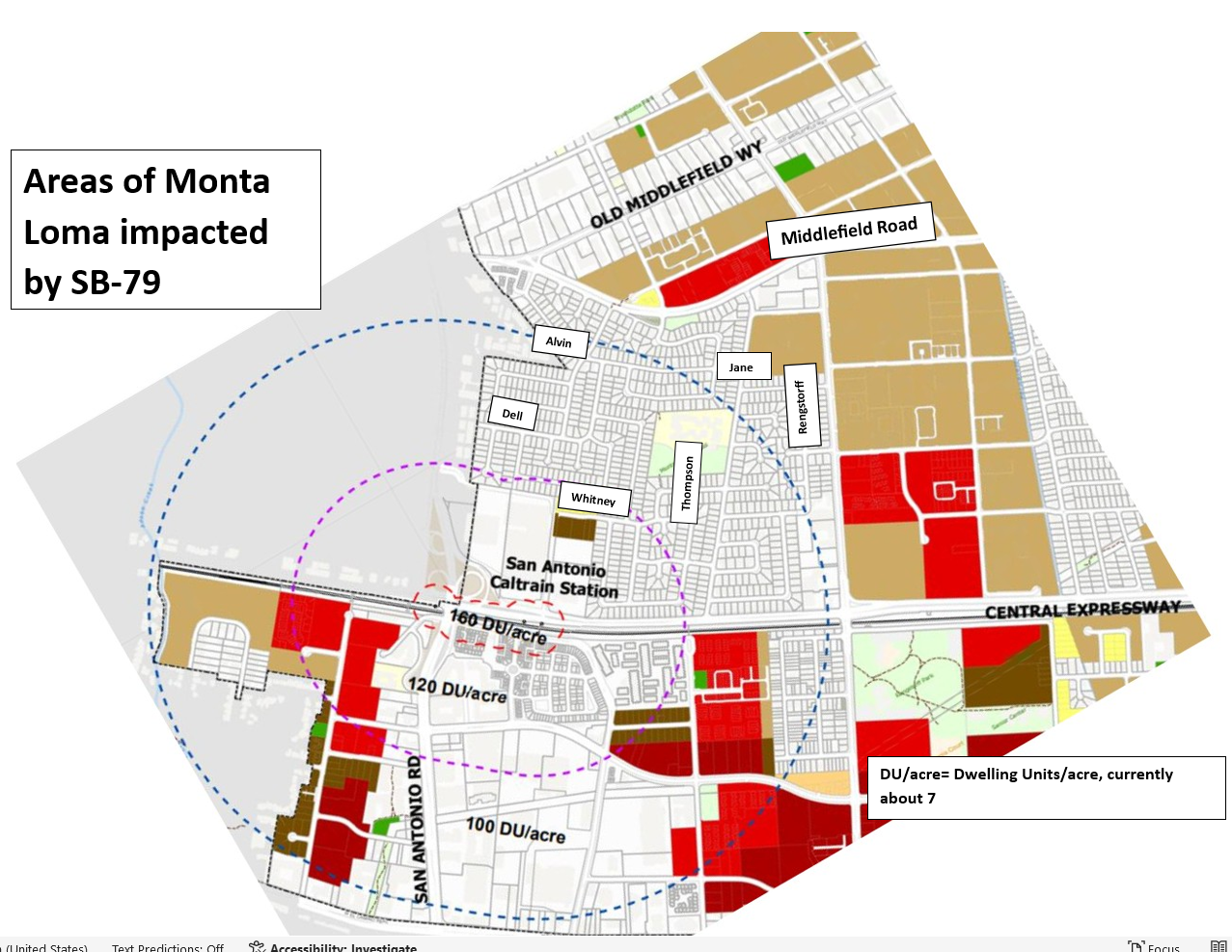
Given that Monta Loma currently has a residential density of about 7 units per acre, the new legislation increases the permitted housing density by more than 10x. Over time, SB-79 is likely to drastically alter the character of our neighborhood, though how long this transition will take remains a subject of debate.
The TOD Alternative Plan?
During the meeting, Director Murdock revealed that cities containing SB-79 transit hubs have the option to submit a Transit-Oriented Development (TOD) Alternative Plan to the State to reallocate the required housing units within each hub area.
However, the State grants cities very little flexibility in modifying SB-79's core requirements:
- Density Transfers: While a TOD alternative plan can reduce permitted density in certain parts of all of a Cities combined SB-79 hubs by up to half, the overall plan must maintain the total number of required units across the hubs by increasing allowed density elsewhere in these areas.
- Building Height Limitations: Building height limits cannot be reduced to less than half of SB-79’s baseline 65- and 75-foot prescriptions.
- Height Increases: To offset lower density in some areas, alternative plans allow building heights up to 100% higher than the standard SB-79 limits in other areas. This could permit structures as tall as 150 feet (approx. 15 stories) within our neighborhood.
Key questions raised during the meeting include:
- Where within the ½-mile radius of the Caltrain station would such massive structures be placed to offset density reductions elsewhere?
- How would these large developments impact local infrastructure, including parks, roads, power, and sewer systems?
- Does modest density reduction in certain spots (down to 32–37-foot buildings) meaningfully preserve neighborhood character if it requires blending those structures with 150-foot-tall towers nearby?
Toward the end of the meeting, Director Murdock noted that Monta Loma’s short-term "safe harbor" may lie in current market conditions: SB-79 permits unit types that buyers are currently not seeking and that developers cannot easily build at a profit. He pointed out that during the first three months of SB-79 being active, nine projects were submitted under the law in Palo Alto, whereas none have been submitted in Monta Loma, and only one has been submitted in downtown Mountain View.
Director Murdock also noted that while the City Council has instructed staff to begin work on an alternative plan for the downtown area, no work has been done regarding options for Monta Loma. He suggested that if the community wishes to explore alternative plan options, it should present its case to the incoming City Council when it convenes in February 2027. Many audience members favored pursuing this strategy, while others questioned how much this significant effort would ultimately achieve.
Additional Resources
- Full Text of SB-79: LegiScan SB-79 Text
- ABAG Analysis: https://abag.ca.gov/sites/default/files/documents/2026-07/SB79-Summary-07172026.pdf?cb=e5ba5b2c
Local Politicians' Input
Despite numerous invitations, Assemblymember Marc Berman—a supporter of the bill—declined to attend the meeting.
Outgoing Mountain View Councilmembers Lucas Ramirez and Alison Hicks attended and answered questions from residents following the presentation. Councilmember Ramirez indicated that while Council has only directed staff to investigate SB-79 alternatives for Old Mountain View (near the Castro Street Station), it is reasonably possible that the new Council could expand the study area to include the San Antonio Caltrain Station if the neighborhood remains engaged and vocal.
Five of the seven current City Council candidates attended the meeting: Robert Cox, Paul Donohue, Alex Amoroso, Silja Paymer, and IdaRose Sylvester. (Candidate Paymer had to leave early due to a prior personal commitment). The remaining candidates presented their positions and answered questions after Director Murdock's presentation.
The September 17th edition of the Mountain View Voice (Candidate Comparison Grid) https://www.mv-voice.com/election/2026/09/17/candidate-comparison-grid-mountain-view-city-council/ summarized candidate positions on SB-79 and housing issues as follows:
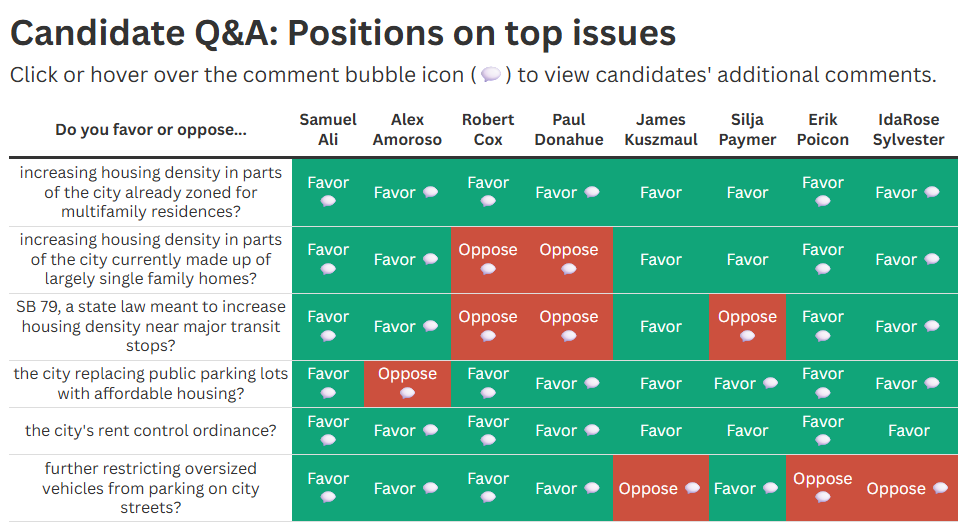
Candidate Positions on SB-79, and its prescriptions for higher density:
- Opposed: Robert Cox, Paul Donohue, Silja Paymer
- In Favor: Samuel Ali, Alex Amoroso, James Kuszmaul, Ida Rose Sylvester, Erik Poicon
Pro-SB-79 candidates who spoke at the forum highlighted the TOD alternative plan as a mechanism to mitigate impacts on existing neighborhoods. However, given the limited flexibility granted to cities under state law, it remains unclear how effective these alternatives would be or whether the candidate statements fully accounted for state-imposed limitations.
Conclusion
The September 23rd meeting clarified that SB-79 went into effect on July 1st, permitting 65- to 75-foot building heights and densities of 100 to 160 units per acre across large parts of Monta Loma. Although the State allows cities to submit an alternative plan, any compliant plan must still accommodate ten times the current residential density of our neighborhood. As a result, an alternative plan alone is unlikely to prevent major long-term changes.
Many experts contend that SB-79 will not cause immediate drastic changes in Monta Loma because current market conditions make high-density development unprofitable at this time.
Ultimately, meaningful long-term modifications to SB-79 must come from state legislators. Local governments have limited power to bypass state requirements. Moving forward, the community will need to work closely with sympathetic local representatives, who in turn will need to coordinate their efforts with other impacted jurisdictions to advocate for adjustments at the state level. This might eventually ensure that the burden for new housing development is balanced with adequate infrastructure, traffic mitigation, and community quality of life, and that it is not unfairly concentrated within a handful of neighborhoods.